Dead Tech Walking: The Artists Resurrecting Broken Electronics Into Stunning Gallery Statements
There's a specific kind of grief that comes with throwing away a piece of technology. You drop it in the bin, or haul it to a donation center, and something that once felt almost alive — that glowed and beeped and responded to your touch — becomes trash. Most of us move on fast. A growing group of artists absolutely refuses to.
Across studios in Brooklyn, Detroit, Los Angeles, and small towns that don't usually make the art-world news cycle, creators are pulling obsolete consumer electronics out of dumpsters, estate sales, and thrift store back rooms and rebuilding them into something else entirely. Something that hits you in the chest a little. CRT televisions stacked floor to ceiling, their screens flickering with manipulated signal. Arcade cabinets rewired to play footage of climate disasters on loop. Broken smartphones fused into mosaic panels that catch the light like stained glass. This is the world of what some people are starting to call "tech salvage art" — and it's getting harder to ignore.
The Junk Pile as Raw Material
Walk into almost any hardware store in America and you'll find bins of discarded cables, cracked screens, and circuit boards nobody wants. For most shoppers, it's background noise. For artists like Chicago-based Renata Solís, it's a candy store.
Solís spent two years collecting broken smartphones from electronics recyclers before she built Pocket Ghosts, a floor-to-ceiling installation of roughly 400 cracked handsets mounted on a mirrored grid. Each phone still has its screen intact — barely. Hairline fractures spider across the glass in patterns that look almost deliberate, almost beautiful. Under gallery lighting, the effect is genuinely stunning. More importantly, it's uncomfortable. You recognize these objects. You've held something exactly like them. You've probably thrown one away without thinking twice.
"People keep asking me if it's about environmentalism," Solís said in a recent studio conversation. "It's partly that, sure. But it's really about intimacy. These things were in people's pockets, their beds, their bathrooms. And then they became garbage. I want you to feel that transition."
That tension — between the familiar and the discarded — runs through almost everything happening in this space right now.
CRT Dreams and Analog Hauntings
If there's one piece of hardware that's become the unofficial mascot of tech salvage art, it's the cathode ray tube television. CRTs carry a weight that flatscreens just don't. They're heavy, literally and figuratively. They glow warm. They buzz. And they're increasingly hard to find in working condition, which makes them both precious and poignant as material.
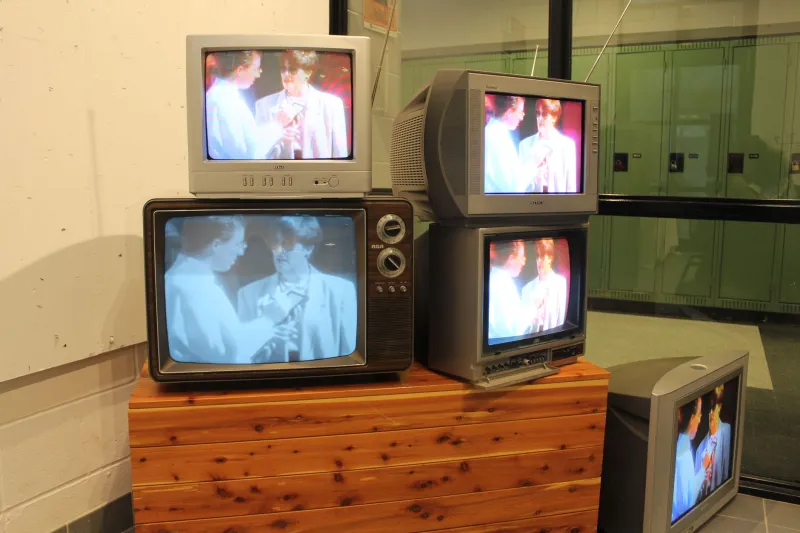
Portland artist Marcus Webb has been working with CRTs for the better part of a decade, and his installations have a quality that's hard to shake. His ongoing series Signal Loss involves stacks of vintage televisions — sometimes a dozen, sometimes fifty — each running slightly different loops of degraded footage. Old news broadcasts. Home videos from the eighties. Weather reports from cities that no longer look the way they did on screen. The audio bleeds between units, creating this ambient wash of half-recognizable sound.
The effect is less like watching television and more like standing inside a collective memory that's slowly coming apart. Webb talks about CRTs as objects that "remember" — that carry the residue of everything they've ever displayed, even if you can't technically retrieve it. Whether or not that's literally true almost doesn't matter. The idea lands.
"There's a reason people get emotional in front of these pieces," Webb explained at a gallery talk earlier this year. "It's not nostalgia exactly. It's something closer to mourning. For a version of the world that moved slower. For attention spans we used to have."
Arcade Logic
Few objects from American consumer culture carry as much collective mythology as the arcade cabinet. The chunky wooden box, the joystick worn smooth by a thousand hands, the pixelated splash screen — these things are practically embedded in the cultural DNA of anyone who grew up in the seventies, eighties, or nineties.
That's exactly why artists like New York-based duo Ferro & Lim have been using them as Trojan horses. Their project Insert Coin to Continue takes fully functional arcade cabinets — sourced from estate sales and shuttered arcade parlors across the Northeast — and rewires them to run original games the duo coded themselves. The games look period-accurate at first glance. Classic color palettes, chunky sprites, simple mechanics. Then you actually play them, and the content starts to shift. One cabinet runs a game where you're navigating a maze that slowly fills with rising water. Another offers what looks like a standard shooter, until you realize the enemies are debt notifications and the player character has a health bar labeled "savings."
It's blunt, sure. But it works, partly because the delivery system is so disarming. You pick up the joystick out of muscle memory, and by the time the message lands, you're already invested.
E-Waste and the Bigger Picture
It's worth being real about the scale of what these artists are working against — or at least alongside. The United States generates roughly 6.9 million tons of e-waste every year, according to the EPA, and only a fraction of that gets properly recycled. The rest ends up in landfills, or gets shipped overseas under circumstances that are often genuinely harmful to the workers handling it.
Tech salvage artists aren't solving that problem. They're not trying to. But they are doing something valuable, which is making the problem visible in a way that a statistics sheet never could. When you're standing in front of Solís's wall of cracked phones, you're not reading about e-waste. You're feeling it. That's a different kind of knowledge.
Some of these artists are also pushing into more explicitly activist territory. Detroit's Collective Disassembly — a loose group of about a dozen artists and engineers — runs free workshops teaching community members to repair and repurpose broken electronics rather than discard them. Their gallery installations double as demonstrations. The work on the wall is made from the same components they'll teach you to work with in the workshop next door.
"We want the gallery and the classroom to be the same space," said collective member Deja Thornton. "Art that doesn't connect to something real in people's lives just sits there looking pretty. We're not really interested in pretty."
Why This Moment
You could ask why this kind of work is resonating so hard right now, and there are a few honest answers. We're living through a period of intense technological acceleration — new devices, new platforms, new formats arriving faster than most people can meaningfully process. Against that backdrop, the act of slowing down and really looking at a piece of obsolete hardware feels almost radical.
There's also something to the way these objects straddle personal and collective history. A VCR isn't just a VCR. It's Friday nights and rental stores and the particular way a rewound tape used to clunk back into place. When an artist puts that object in a gallery and asks you to think about it differently, they're also asking you to think about the culture that produced it — and the culture that decided to throw it out.
Tech salvage art isn't a movement with a manifesto or a unified aesthetic. It's more like a shared instinct: that the things we discard deserve a second look. That broken doesn't mean worthless. That sometimes the most honest thing an object can do is fall apart, and the most honest thing an artist can do is be there when it does.