Beautiful Breakdowns: Why the Art World Is Falling in Love With Corrupted Code
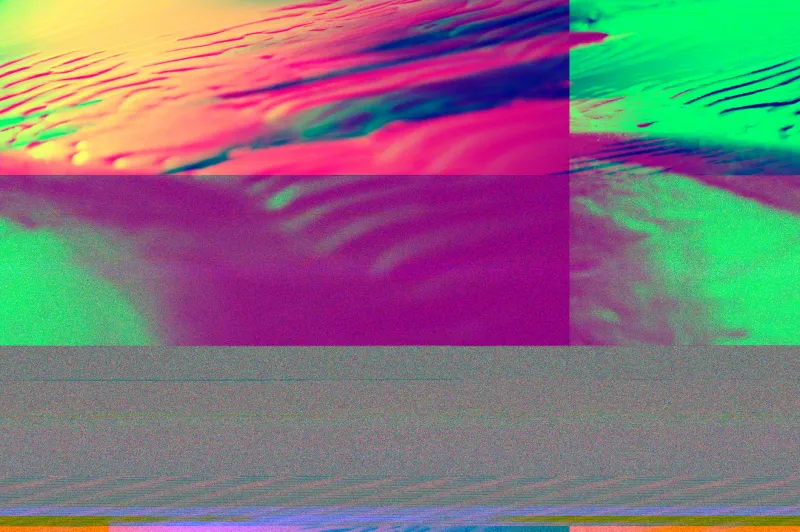
There's a moment most of us have experienced — a video freezes mid-frame, colors smear across the screen like wet paint, pixels scatter into something that looks almost intentional. Usually, we curse our Wi-Fi and move on. But a community of artists across the US and beyond has been pausing at that exact moment, leaning in, and asking: what if this is the most honest thing a screen has ever shown me?
Glitch art isn't new. It's been lurking in experimental circles since the early days of consumer electronics. But right now, in a cultural moment defined by algorithmic perfection and AI-generated smoothness, the deliberate embrace of digital failure feels less like a niche experiment and more like a full-throated rebellion.
Breaking Things on Purpose
The core practice is deceptively simple: you take a digital file — an image, a video, an audio track — and you mess with it. Not randomly, but with a kind of controlled recklessness. Artists might open a JPEG in a text editor and manually delete chunks of code. They'll run audio files through circuit-bent hardware, letting voltage irregularities scramble the signal. Some manipulate data streams in real time during live performances, turning software crashes into something closer to jazz improvisation.
New York-based visual artist Rosa Menkman, whose theoretical writing on glitch has become something of a foundational text for the community, describes the process as "discovering the inherent language of the machine." When a file corrupts, you're not seeing an error — you're seeing the raw architecture of how data is stored and interpreted, stripped of its decorative layer. It's the digital equivalent of tearing back drywall and finding the studs.
For artists working in this space, that exposure isn't ugly. It's revelatory.
The Sound of Something Snapping
Glitch aesthetics aren't limited to the visual. The music world has its own thriving corner of deliberate dysfunction, and it's been quietly influential for decades. Producers working in genres loosely tagged as glitch-hop, IDM (Intelligent Dance Music), and noise have long treated digital artifacts — skips, stutters, bit-crushing distortion — as legitimate instruments rather than things to be edited out.
Artists like Arca and Prefuse 73 brought these textures into mainstream conversation, but the underground scene runs much deeper. Bedroom producers in cities like Chicago, Portland, and Atlanta are building entire sonic worlds from corrupted samples and malfunctioning synthesizers. The aesthetic has seeped into hip-hop production, experimental R&B, and even some corners of pop, where a strategically placed glitch can signal authenticity in a way that pristine production simply can't.
There's something almost political about it. In an era where music can be generated by AI with zero human error, choosing to include the sounds of things falling apart is a statement. It says: a human being was here, struggling with this, and that struggle is worth hearing.
Fashion, Screens, and the Glitch-Industrial Complex
The visual language of glitch has also made serious inroads into fashion and commercial design — which cuts both ways. On one hand, seeing corrupted aesthetics on album covers for major label artists or in Nike campaign visuals suggests the underground has real cultural pull. On the other hand, it raises the question that haunts every subculture that gets noticed: once it's been commodified, does it still mean anything?
Designers like Jeremy Scott and collectives like HITO Steyerl have incorporated glitch-adjacent visuals into work that sits comfortably in both gallery spaces and commercial contexts. Streetwear brands have leaned into pixelated degradation as a graphic motif. The imagery has become shorthand for a certain kind of digital-native cool — tech-savvy but suspicious of tech's promises.
The tension is real, but longtime practitioners mostly seem unbothered. The tools for making glitch art are still cheap, weird, and inaccessible enough to keep the work from being fully domesticated. You can't just buy a plugin that perfectly replicates what happens when you genuinely corrupt a file. The unpredictability is the point, and unpredictability doesn't scale easily.
Why Now, Though?
The timing of glitch art's current cultural moment makes a lot of sense when you zoom out. We're living through a period of almost aggressive digital perfectionism. Social media filters smooth out skin, AI upscaling sharpens old footage, generative image tools produce technically flawless compositions on demand. The dominant visual language of the internet is one of frictionless polish.
Glitch art pushes back against all of that — hard. It insists on the visible presence of process, failure, and materiality. Even in a digital medium, it makes the work feel made rather than generated. There's a vulnerability to it. When you show the corrupted version of something, you're admitting that the underlying system is fragile, imperfect, subject to entropy. That's not a comfortable admission in a tech culture that sells us the fantasy of seamless functionality.
But discomfort, as any good artist knows, is often where the most interesting conversations start.
Finding the Community
If you want to fall down this particular rabbit hole, the entry points are everywhere. Platforms like Glitch Artists Collective on Facebook (yes, still) and scattered Discord servers host communities where people share techniques, critique each other's work, and debate the ethics of glitch's commercial crossover. Tumblr, despite everything, remains a weirdly vital archive of early glitch visual culture.
In physical spaces, look for experimental media festivals in cities like Los Angeles, New York, and Austin, where glitch art frequently appears alongside net art, VR installations, and other digitally native practices. Organizations like Eyebeam in New York have long championed this kind of work, offering residencies and exhibition space for artists who treat technology as a site of critical inquiry rather than just a delivery mechanism.
The work being made right now — by artists who grew up entirely inside digital culture and are now starting to pick at its seams — is some of the most genuinely exciting stuff happening in contemporary art. It doesn't require a gallery visit or a hefty price tag to appreciate. Sometimes it just requires pausing the next time your screen does something unexpected, and asking yourself what you're actually looking at.
Because sometimes what looks like an error is the most truthful thing in the room.