Skin Deep and Rule-Free: Inside America's DIY Tattoo Underground
Skin Deep and Rule-Free: Inside America's DIY Tattoo Underground
There's a tattoo on Marisol Vega's left forearm that you will never find in a flash book. It's a loose, slightly wobbly rendering of her grandmother's hands holding a glass of agua de jamaica, done by a friend in a Brooklyn apartment on a Tuesday night two years ago. No booking fee. No sterile consultation. Just a needle, some ink, a playlist, and trust.
"It feels like mine in a way that nothing from a shop ever has," she says. "It's imperfect, and that's the whole point."
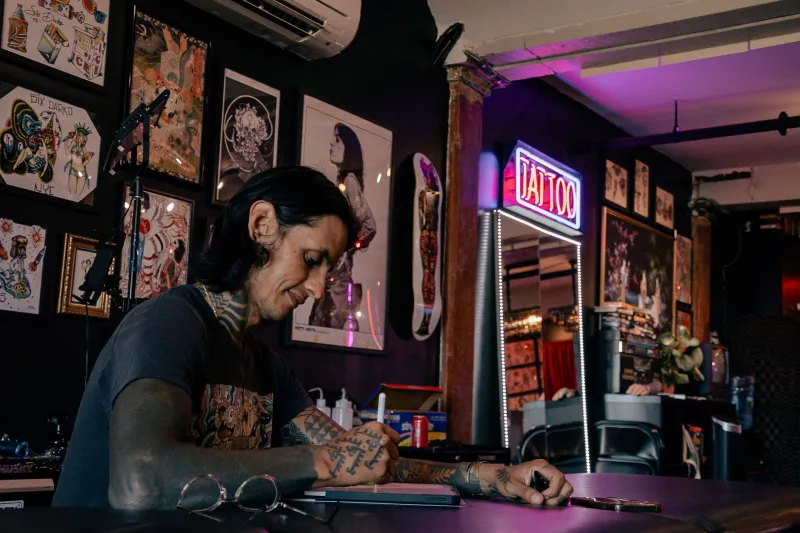
Marisol isn't alone. Across the country, a sprawling, decentralized movement of self-taught and underground tattoo artists is quietly reshaping what body art can look like — and who gets to make it. Fueled by social media, community networks, and a collective exhaustion with the gatekeeping culture of traditional tattoo shops, these artists are building something that feels genuinely new, even as it reaches back to the oldest traditions of marking skin.
The Shop Model Was Never for Everyone
Conventional tattoo culture in America has a well-documented hierarchy. You apprentice under a master, often for years, sometimes unpaid or near-unpaid. You learn the shop's way. You work your way up. For decades, this system produced technically skilled artists and maintained certain standards — but it also reproduced a lot of the industry's worst tendencies: gatekeeping along racial and gender lines, a macho shop culture that alienated queer artists and clients, and a commercial aesthetic that prioritized realism and traditional styles over experimentation.
The DIY underground didn't emerge to spite that system, exactly. It emerged because a lot of people — particularly queer folks, artists of color, and those without the financial runway to apprentice for free — simply needed another way in. What they built in that necessity is something the mainstream industry is still trying to figure out.
In cities like Los Angeles, Chicago, and Richmond, Virginia, you'll find artists operating out of home studios with carefully curated Instagram accounts and waitlists that rival any brick-and-mortar shop. Their work doesn't look like traditional tattoo art. It looks like illustration, printmaking, naive art, folk imagery, and abstract design — often all at once. It's intimate. It's weird. It's deeply personal in a way that mass-market tattooing rarely is.
The Artists Doing It Their Way
Take Dez Okafor, a 27-year-old stick-and-poke artist based in Atlanta who started tattooing friends during the early pandemic lockdowns. His portfolio reads like a zine come to life — hand-lettered phrases in crumbling serif fonts, small botanical illustrations that look lifted from a 19th-century field guide, abstract geometric patterns that he says come from "just sitting with the person and seeing what shape they feel like that day."
"I never wanted to be a tattoo artist in the traditional sense," Dez explains. "I wanted to make marks on people that meant something specific to them. The shop model wasn't built for that kind of conversation."
Out in Portland, Oregon, Yuki Tanaka works from a converted sunporch, specializing in what she describes as "soft surrealism" — dreamlike imagery that blends Japanese folk motifs with imagery drawn from Pacific Northwest nature and queer mythology. Her clients come specifically for the experience: the conversation beforehand, the collaborative design process, the way a session feels less like a medical procedure and more like a studio visit.
And then there's Marcus Webb in Detroit, who learned to tattoo by watching YouTube tutorials and practicing on synthetic skin for eight months before touching a human. His style is raw and graphic — bold black lines, deliberate imperfections, work that celebrates what he calls "the handmade quality that machines try to erase." He sees the slight tremor in a hand-poked line not as a flaw but as evidence of a real human making something real.
The Safety Question — Because It Has to Be Asked
Here's where the conversation gets complicated, and it would be dishonest to skip it. Tattooing unlicensed is illegal in most US states. Licensing requirements exist for legitimate public health reasons: bloodborne pathogen training, sterilization protocols, aftercare standards. When those practices aren't followed, people get infections. In rare cases, people get seriously hurt.
The underground artists who are doing this thoughtfully — and many of them are — will tell you they've educated themselves rigorously. They use single-use needles, medical-grade ink, proper aftercare protocols. They've taken bloodborne pathogen certification courses online. They are, in practice, as safe as many licensed shops. But "in practice" is doing a lot of work in that sentence, and there's no regulatory body checking.
The honest tension is this: the licensing system in America has genuine public health value, and it's also been used as a tool to exclude artists who can't afford the apprenticeship pipeline or who don't fit the culture of traditional shops. Both of these things are true simultaneously. The underground doesn't resolve that tension — it just lives inside it.
What advocates in this space are pushing for is reform rather than abolition: streamlined licensing pathways that don't require years of unpaid labor, home studio permits modeled on cottage food laws, and harm reduction resources specifically designed for independent artists. Some states are slowly moving in that direction. Most aren't there yet.
A Living Art Form Shaped by Community
What strikes you when you spend time in this world is how much it functions as a genuine community rather than just a collection of individual artists. Underground tattooers share technique videos in private Discord servers. They post educational content about safe practice. They refer clients to each other based on style fit. They show up for each other in ways that the competitive, hierarchical shop culture often doesn't.
There's also a reclamation happening around who tattoos have historically been for and what they've meant. Many of the artists in this space are drawing on traditions — Indigenous marking practices, South and Southeast Asian tattooing, African scarification and adornment — that predate Western tattoo culture by centuries. They're pushing back against the narrative that "real" tattooing means American traditional or Japanese neo-traditional, and insisting that the full global history of body modification belongs in this conversation.
Marisol's grandmother's hands are still on her arm. The ink has settled now, softened slightly at the edges, the way hand-poked work does. She's gotten two more tattoos from underground artists since then — a small moth on her collarbone, a line of text along her ribs — and she has no plans to walk into a shop.
"There's something about knowing the person who made this," she says. "Knowing why they made it the way they did. It's not just decoration. It's a record of a relationship."
That's what the underground is really about. Not rebellion for its own sake, not a rejection of craft or safety or professionalism. It's a demand that body art stay human — messy, personal, made between people who actually know each other. The rules were always someone else's. These artists are writing their own.