No Stream, No Problem: The Underground Musicians Hiding Their Music in Plain Sight
Somewhere in a modded version of a farming simulator, there is an album. You find it by walking your in-game character to a specific barn at a specific in-game time of day, interacting with a hay bale that looks identical to every other hay bale on the map, and waiting. Then music starts playing — an entire record, sequenced and sequenced deliberately, that exists nowhere else on the internet. No Bandcamp page. No SoundCloud link. No streaming profile. Just a barn, a hay bale, and whoever figured out the coordinates.
This is not an isolated stunt. It's part of a broader and genuinely fascinating movement among independent musicians who've decided that the streaming economy isn't just financially bad for artists — it's aesthetically bad for music. And they're building their audiences in ways that would have seemed either visionary or unhinged just a few years ago.
The Streaming Math Nobody Wins
The economics of streaming are by now well-documented and thoroughly depressing. Spotify pays somewhere between $0.003 and $0.005 per stream, which means an independent artist needs roughly 250,000 streams a month to clear minimum wage. Most don't come close. The platforms have responded to this critique with a combination of marginal rate adjustments and PR, but the fundamental structure — massive catalogs, algorithm-driven discovery, an emphasis on playlist placement over artist identity — remains intact.
What's newer, and more interesting, is the aesthetic critique. A growing number of musicians argue that the infinite-access model has fundamentally changed how people relate to music. When everything is available everywhere always, nothing feels rare. Nothing feels like it belongs to you specifically. The listening experience becomes passive, ambient, algorithmic — a soundtrack to other activities rather than a thing worth paying attention to on its own terms.
So some of them are engineering scarcity back into the equation.
The Encrypted File Circuit
One approach that's gained traction in certain corners of the experimental music world involves releasing music as encrypted files distributed through deliberately obscure channels — private mailing lists, physical USB drives sold at shows, file-sharing communities that require an invitation to join. The decryption key gets distributed separately, sometimes through puzzles, sometimes through other pieces of media, sometimes simply through word of mouth among people who were already paying attention.
It sounds like a logistical nightmare, and it kind of is. But artists who've used this method describe something unexpected happening on the listener end: people actually sit with the music. They listen intentionally. They share it selectively, with people they think will care, rather than blasting it into the social media void. The friction of access, it turns out, can create investment.
Producer and composer Delphine Ashworth, who records under the name Crestfall, released her 2022 record Quiet Infrastructure exclusively through a mailing list of 340 subscribers. Each subscriber received a download link that expired after 72 hours. There was no re-release, no archiving, no way to access it after the window closed. "I wanted people to know that this was a thing that happened," she told Meshune. "Not a thing that's always available. Music used to work like that. A performance happened and then it was gone. I wanted some of that back."
Quiet Infrastructure has never been streamed. It's been written about in three different music publications. There's a 40-minute YouTube video essay about it made by someone who received a copy. Ashworth has no idea how many people have actually heard it at this point, and she says she prefers it that way.
Music as Installation, Not Product
The video game embedding approach — like that farming simulator album — represents a different strategy, one that treats music as something embedded in experience rather than extracted from it. Several artists have partnered with indie game developers to hide albums, EPs, or individual tracks inside game worlds, accessible only to players who discover the right trigger.
The appeal is partly about discovery and partly about context. Music heard while wandering a hand-drawn digital landscape at 2 AM hits differently than the same music heard through a playlist. The artists doing this are thinking about placement the way a film composer thinks about scoring — what does this environment do to this sound, and what does this sound do to this environment?
There's also a community dimension. Players who find hidden music share coordinates and clues with each other, building a kind of collective scavenger hunt that generates its own social energy. The audience becomes active participants in the distribution of the work, which changes the relationship between listener and artist in ways that passive streaming never could.
The Physical Object Revival
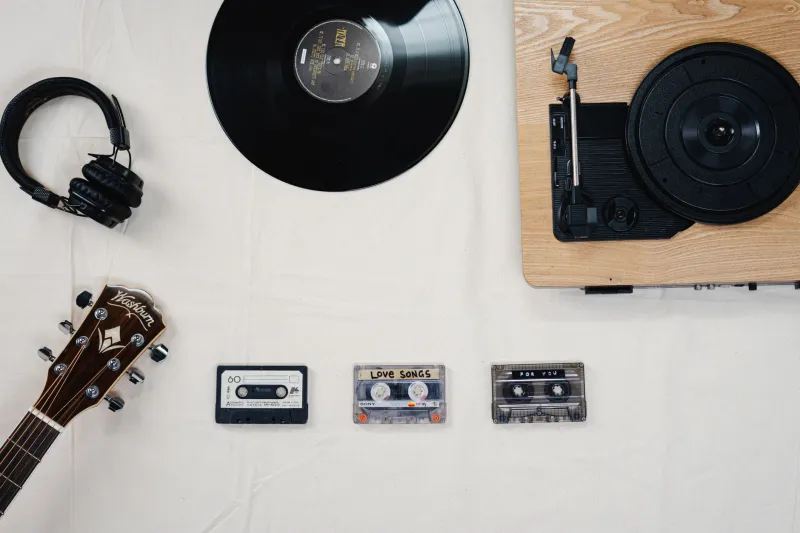
Not every artist in this space is working digitally. A parallel movement is happening in the physical realm, with musicians releasing music exclusively on formats that require deliberate, hardware-specific engagement. Cassette tapes have been resurgent for a while, but the more extreme version involves formats that are genuinely inconvenient: 8-track cartridges, reel-to-reel tapes, even custom-built playback devices that only work with specific releases.
Chicago-based ambient musician Terrence Holt released his last album on a custom-built device that looked like a small wooden box with a single button. Press the button, the album plays from the beginning. You can't skip. You can't rewind. You can't adjust the volume — it plays at one volume, the volume Holt decided was correct. He made 200 of them. They sold out in four days through his mailing list. Secondary market prices have gotten silly.
"I wanted to make something that had opinions," Holt explained. "Streaming is infinitely accommodating. You can listen to anything in any order at any volume in any context. I wanted to make something that pushed back a little."
Who's Actually Listening?
The obvious question is whether this is all just clever marketing dressed up as philosophy — a way to generate buzz by manufacturing artificial scarcity. It's a fair challenge. The musicians doing this stuff are not naive; they understand that obscurity has its own kind of appeal, that the story of an inaccessible album is itself a form of promotion.
But spend time in the communities that form around this music and the cynical read starts to feel incomplete. These are genuinely devoted audiences — people who've spent hours hunting for a hidden track, who maintain forums dedicated to decoding release puzzles, who trade physical media through the mail like it's 1995. The engagement is real, even if the numbers are small.
Small, in fact, might be the point. In a streaming economy that treats audience size as the primary metric of value, building a community of 500 deeply invested listeners instead of 50,000 passive ones is a genuine act of resistance. It's a bet that music means more when it means something to find it.
The barn is still there, by the way. The hay bale still works. And somewhere, right now, someone is figuring out how to get there.