Slow on Purpose: The Artists Choosing Inefficiency as a Creative Philosophy
Jordan Reyes spent four months making a chair. Not designing a chair — making one, by hand, using traditional joinery techniques he learned from a YouTube series and then a week-long workshop in Vermont. No power tools after the first week. He's a graphic designer by training and profession, someone who spends most of his working hours in front of screens moving pixels with precision and speed. The chair was something else entirely.
"I kept making mistakes," he said, sitting in the chair in question, which is genuinely beautiful in a slightly imperfect way that photographs don't quite capture. "And fixing the mistakes took longer than making the thing in the first place. But I was so present for all of it. I haven't been that present making anything in years."
Reyes is not alone in this. Across the country, in studios and kitchens and garages and community workshops, a recognizable pattern is emerging: young creative people — designers, programmers, photographers, musicians — are deliberately choosing the slower, harder, less efficient path. And they're not doing it ironically.
The Efficiency Trap
The creative tools available to anyone with a laptop and an internet connection in 2024 are genuinely astonishing. A graphic designer can generate dozens of layout variations in seconds. A musician can produce a fully realized track without touching a physical instrument. A programmer can get working code from a chatbot in under a minute. The barrier between idea and output has never been lower.
And yet something keeps getting lost in the speed. Ask the people who've stepped back from maximum efficiency what they're missing and you get variations on the same answer: the process itself. The thinking that happens between the intention and the result. The mistakes that turn into discoveries. The physical memory that builds up in hands doing repetitive work.
There's a concept in craft traditions called tacit knowledge — the kind of understanding that lives in the body rather than the mind, that can't be written down or transferred through instruction alone. You develop it by doing things slowly, repeatedly, with your hands. And it turns out that tacit knowledge shapes creative decisions in ways that are hard to replicate when you skip the slow part.
The Pottery Boom That Isn't About Pottery
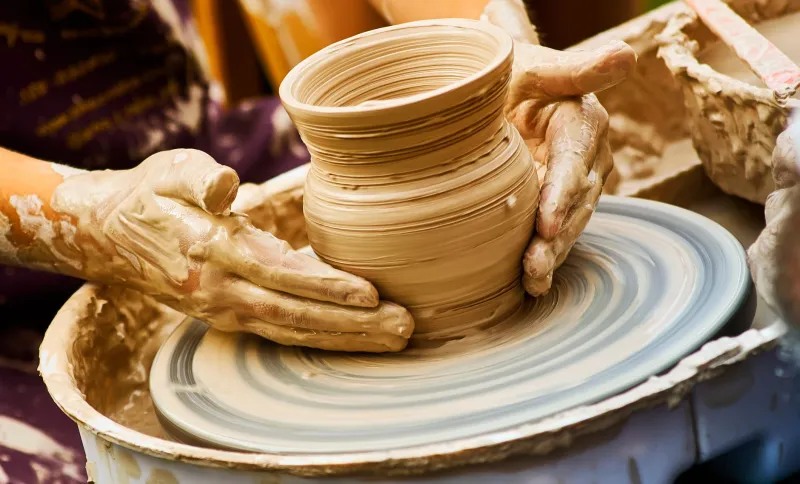
The numbers on ceramics enrollment at community studios across the US have been climbing for several years running. That's partially a pandemic-era story — people stuck at home discovered making things — but it hasn't reversed the way pandemic trends usually do. If anything, the interest has deepened and spread into younger demographics.
What's interesting is who's showing up. Studio owners describe a consistent type: people in tech-adjacent fields, creatives who work primarily in digital mediums, folks in their mid-twenties to late thirties who describe their day jobs in terms of speed and output and optimization. They come to ceramics specifically because it resists those qualities.
Clay has opinions. It dries at its own pace. It cracks if you push it too hard. A piece that would take fifteen minutes to model in 3D software might take three weeks to build, dry, fire, and glaze by hand — and might crack in the kiln anyway. For people whose professional lives involve constant, frictionless control, that resistance is apparently the entire appeal.
Philadelphia-based designer Kira Sung has been throwing pottery for two years alongside her visual design practice. She describes the relationship between the two as genuinely generative: "Working with clay has changed how I make decisions in digital work. I'm more patient. I'm less attached to the first idea. I've learned to see a mistake as information rather than failure."
Code by Hand, Then by Computer
Among programmers and software developers, a parallel practice has emerged that sounds almost like a joke until you understand the reasoning: writing code by hand, in notebooks, before typing it into a computer.
The practice has roots in older programming pedagogy — before personal computers were ubiquitous, writing code on paper was just how you learned. But for younger developers doing it now, the motivation is different. It's about slowing down the thinking process, forcing yourself to understand what you're actually trying to do before the computer starts offering autocomplete suggestions and error corrections.
Developer and artist Milo Ferreira, who works on generative art projects in his spare time, keeps dedicated notebooks for every project — not pseudocode, but actual syntax, written out by hand. "When you're typing, the environment is always responding to you. It's correcting you, suggesting things, filling in gaps. You can write a lot of code without really understanding what you've written. Writing by hand, there's no feedback loop. It's just you and the logic."
He's quick to point out that this isn't about rejecting computers — he uses them constantly and enthusiastically. It's about creating a deliberate friction at the beginning of the process, a forced slowdown that shapes everything that comes after.
The Color Palette Minimalists
In visual design and illustration, a growing cohort of practitioners is imposing strict, self-chosen constraints on their work — most commonly around color. Where professional design tools offer millions of colors and sophisticated gradient systems, these designers are limiting themselves to two, three, or four colors per project, chosen in advance and never supplemented.
The constraint sounds minor until you work under it. Color choices cascade through every decision in a visual composition. Limiting the palette forces you to solve problems with shape, value, and composition rather than reaching for another hue. It's harder. It takes longer. And practitioners describe the resulting work as more coherent, more intentional, more distinctly theirs.
Illustrator Bex Calloway, based in Austin, started imposing two-color limits on her client work two years ago. "I was spending so much time on color decisions. Just spinning out. Having a constraint removed the spinning. Now I spend that time on everything else, and the work is better for it."
Is This Resistance or Nostalgia?
The obvious critique of all of this is that it's a form of privilege — the luxury of slowness available only to people who can afford to be inefficient. There's something to that. Deliberately hand-building furniture or spending a week on a design that could be done in an afternoon is not available to everyone, economically or temporally.
But the more interesting question is what this movement is actually responding to. It's tempting to read it as nostalgia — a romantic attachment to older ways of making things. But talking to the people involved, what comes through more consistently is something different: a genuine concern about what gets lost when creative work is fully optimized.
The fear isn't that AI will take their jobs, exactly. It's subtler than that. It's that the continuous pressure toward speed and efficiency is eroding something in the creative process itself — the thinking, the physical knowledge, the relationship between maker and material — that produces work worth caring about.
Making a chair in four months won't solve that problem at scale. But Jordan Reyes sits in his slightly imperfect chair and says he makes better design decisions now than he did before he built it. That's not nothing. In fact, in a moment when everything is trying to go faster, it might be exactly the point.